“Bring Them Home Now”: how a visual campaign turns a crisis into something personal
An analysis of the campaign of the Hostages and Missing Families Forum in Israel, born after October 7, 2023: five visual pieces read with the tools of visual communication (framing, symbol, studium and punctum, the presence of the absent) to understand why they work and what they cost.
The case
On October 7, 2023 Hamas kidnapped 251 people. Within days, a WhatsApp group became a families’ forum with a single, non-partisan mission: bring them all home. The campaign came out of civil society and resonated globally because it turned a tragedy into something personal and collective at the same time. Our thesis: it did so with strategic framing, symbols and a staging of authenticity that activates empathy and urgency.
- 2023, days after October 7: Israeli artists in New York print the first “Kidnapped” posters.
- 2023: the first “empty Shabbat table” in Hostages Square in Tel Aviv, with 200 chairs; weeks later, the yellow ribbon as a symbol of hope and return.
- 2024: the full-scale replica of a tunnel in the square; later, dozens of women re-enact in Tel Aviv the scene of Naama Levy’s abduction.
- 2025: videos of weakened hostages trigger emergency protests. At the time of the work, 50 hostages were still in Gaza.
We chose five pieces and read them one by one with the course concepts: thematic and episodic framing, priming, studium and punctum (Barthes), mythologies, the presence of the absent (Azoulay), the semiotics of color and object (Kress and van Leeuwen), authenticity and visual activism.
1 · The posters with name and age
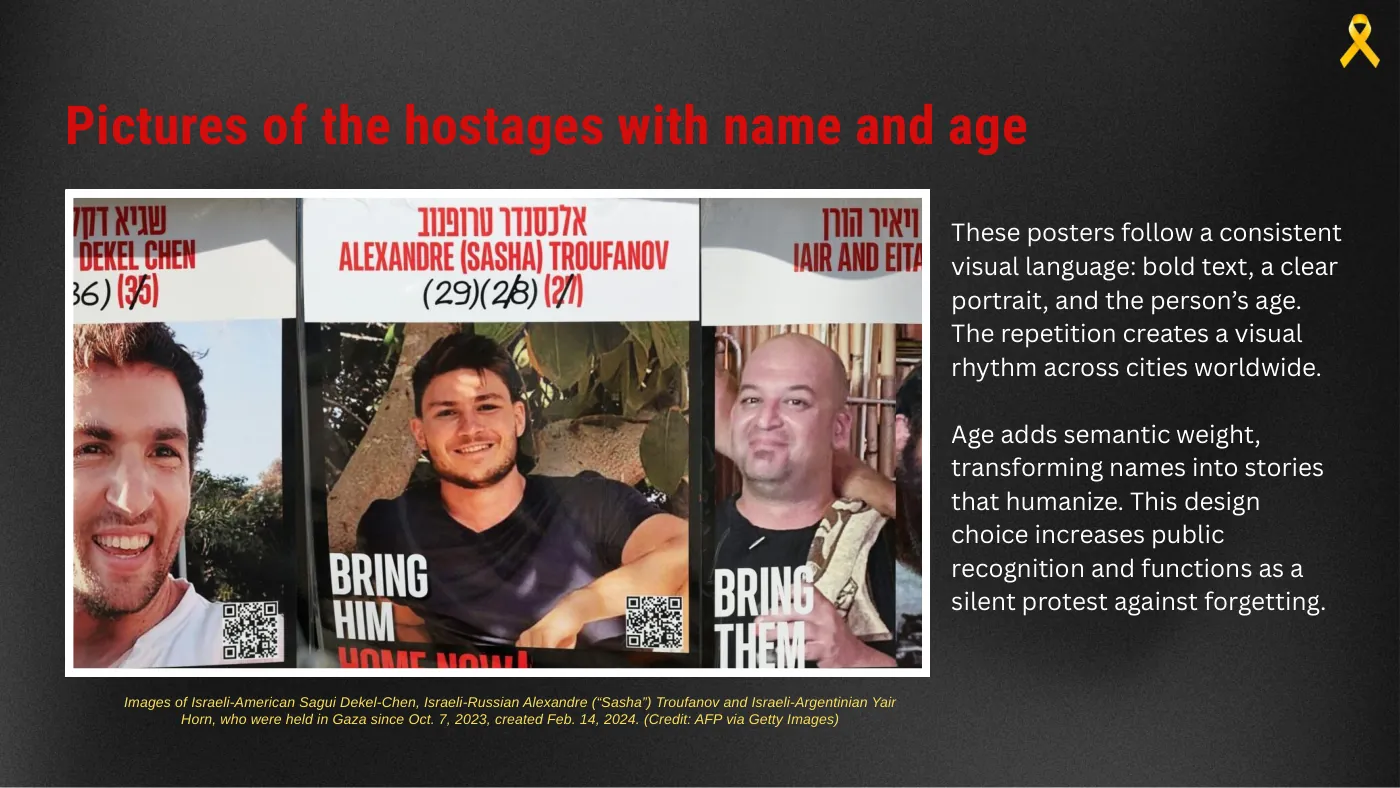
A constant visual language: bold text, a clear portrait, the age. Thematic framing: each individual case becomes part of a collective problem. Repetition in cities around the world creates visual rhythm and constant priming. The direct gaze of the faces produces immediate contact with the passer-by. The face and the name are the studium, the information; the age and the ubiquity seek the punctum, the detail that wounds and humanizes. It is also a silent protest against forgetting. The cost: fatigue from saturation and the risk that individual pain gets standardized.
2 · The tunnel replica
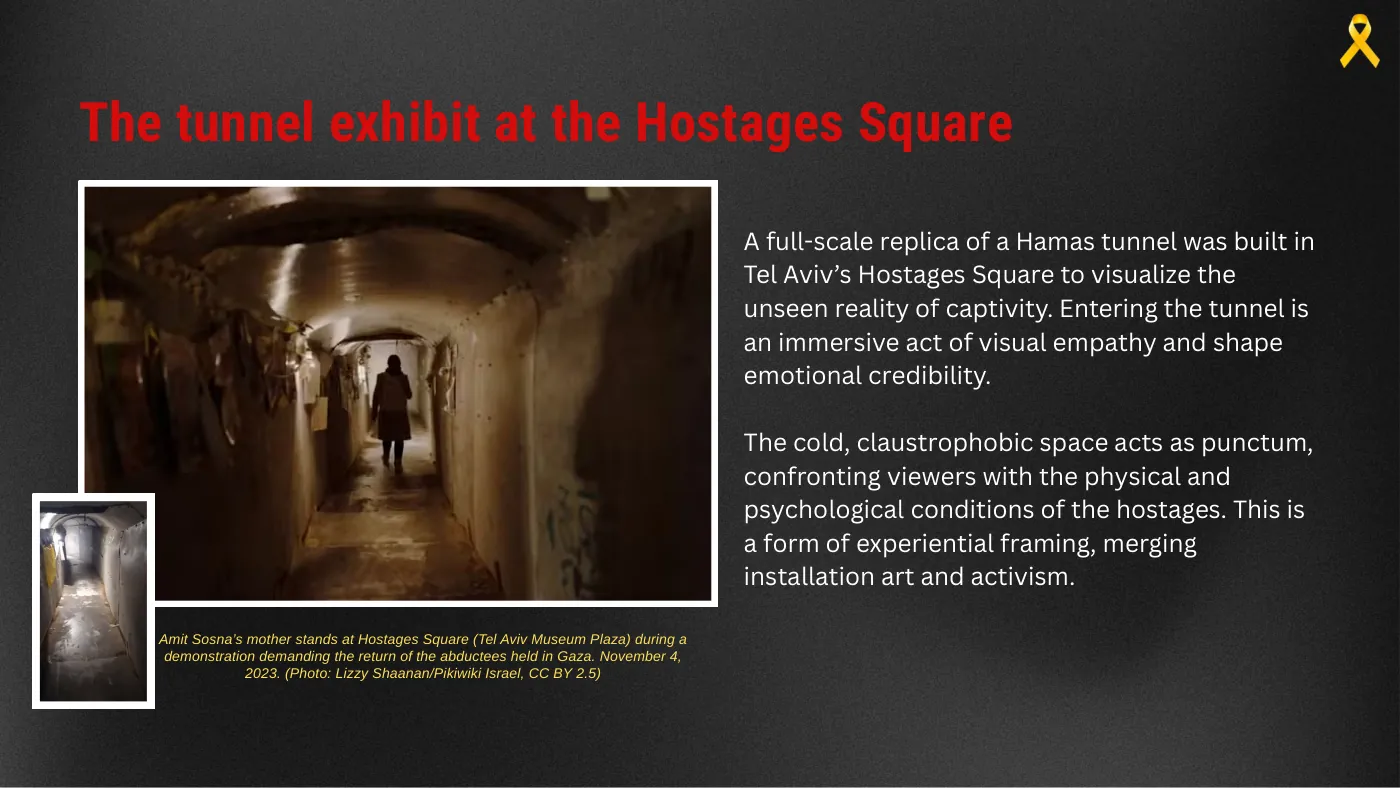
A full-scale replica of a Hamas tunnel in Hostages Square in Tel Aviv, to make visible a reality nobody sees. Entering is an act of visual empathy that builds emotional credibility. The cold, claustrophobic space works as punctum: it confronts whoever enters with the physical and psychological conditions of captivity. It is experiential framing: art installation and activism in one object.
3 · The empty Shabbat table
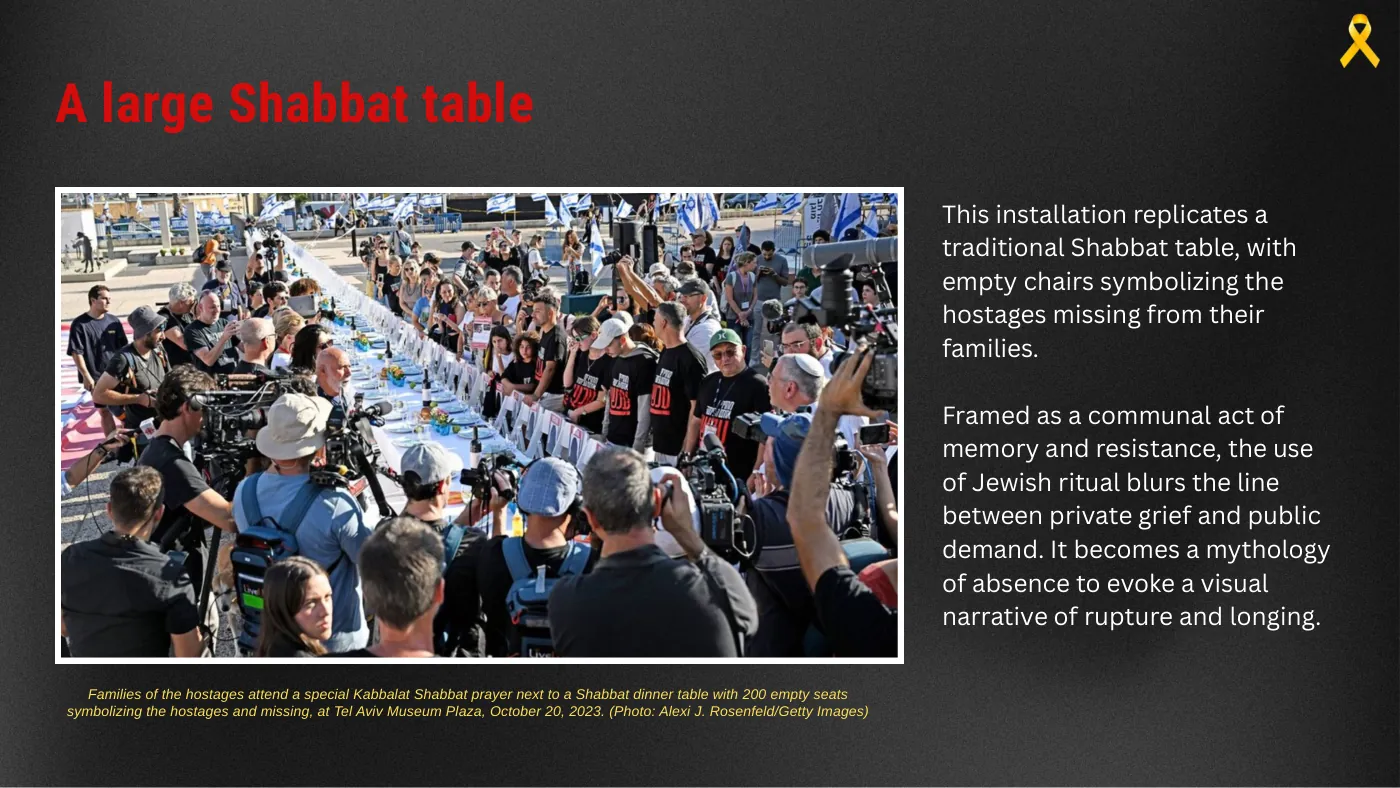
A Shabbat table with 200 empty chairs. Episodic framing: it re-creates a concrete ritual moment and interrupts it. The ritual is a central mythology of Jewish culture, and its interruption becomes a symbol of the crisis; the table extending without end is the metaphor of a tragedy that seems endless. The empty chair is the punctum of absence: Azoulay’s presence of the absent. Color speaks too: the white table of the ritual and the relatives in black. The cost: it stays limited to the physical space and can be read as a solely religious message.
4 · The teddy bears
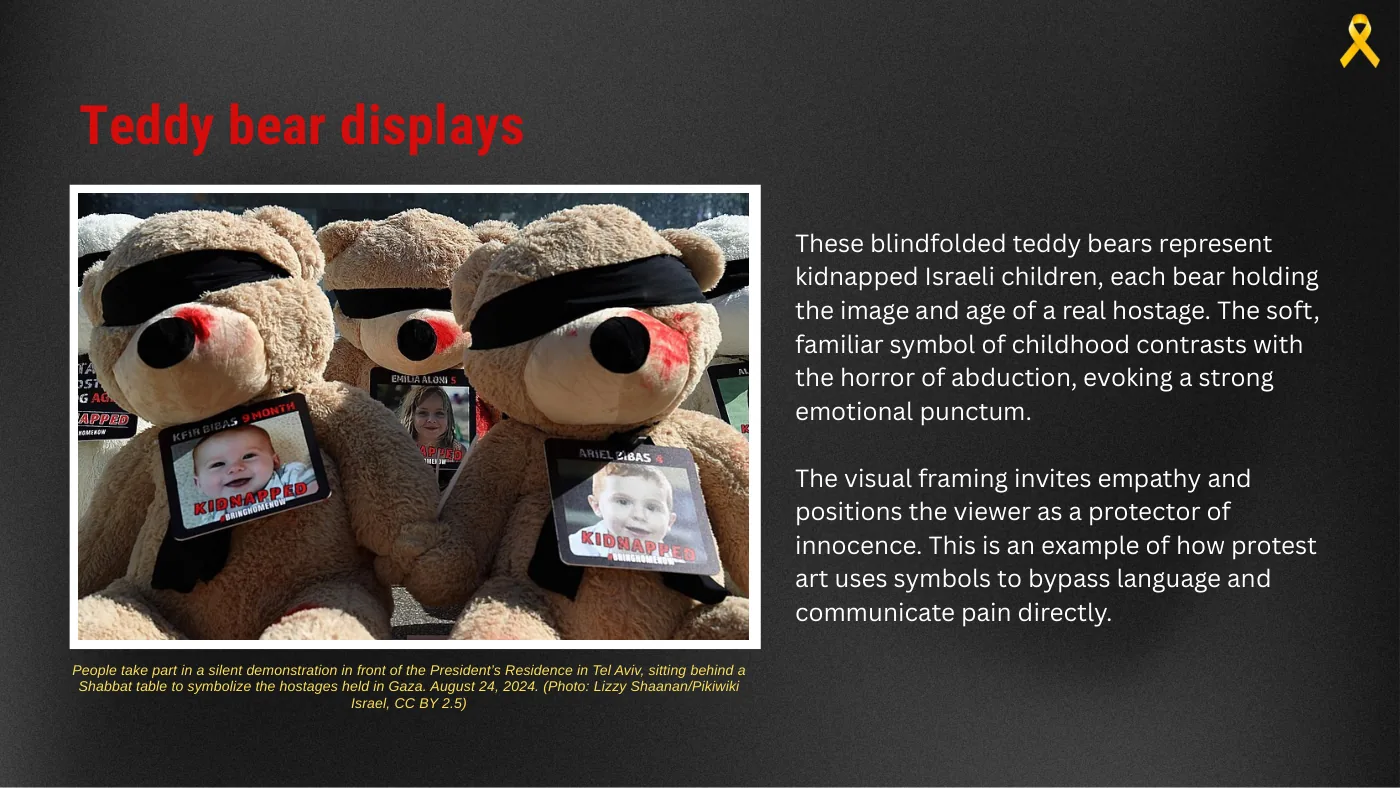
Blindfolded bears, each with the photo and the age of a kidnapped child. The soft, familiar symbol of childhood against the horror of abduction: a strong emotional punctum. The visual framing invites empathy and places the viewer as a protector of innocence. It is the clearest example of how protest art uses symbols to bypass language and communicate pain directly.
5 · The re-enactment of Naama Levy
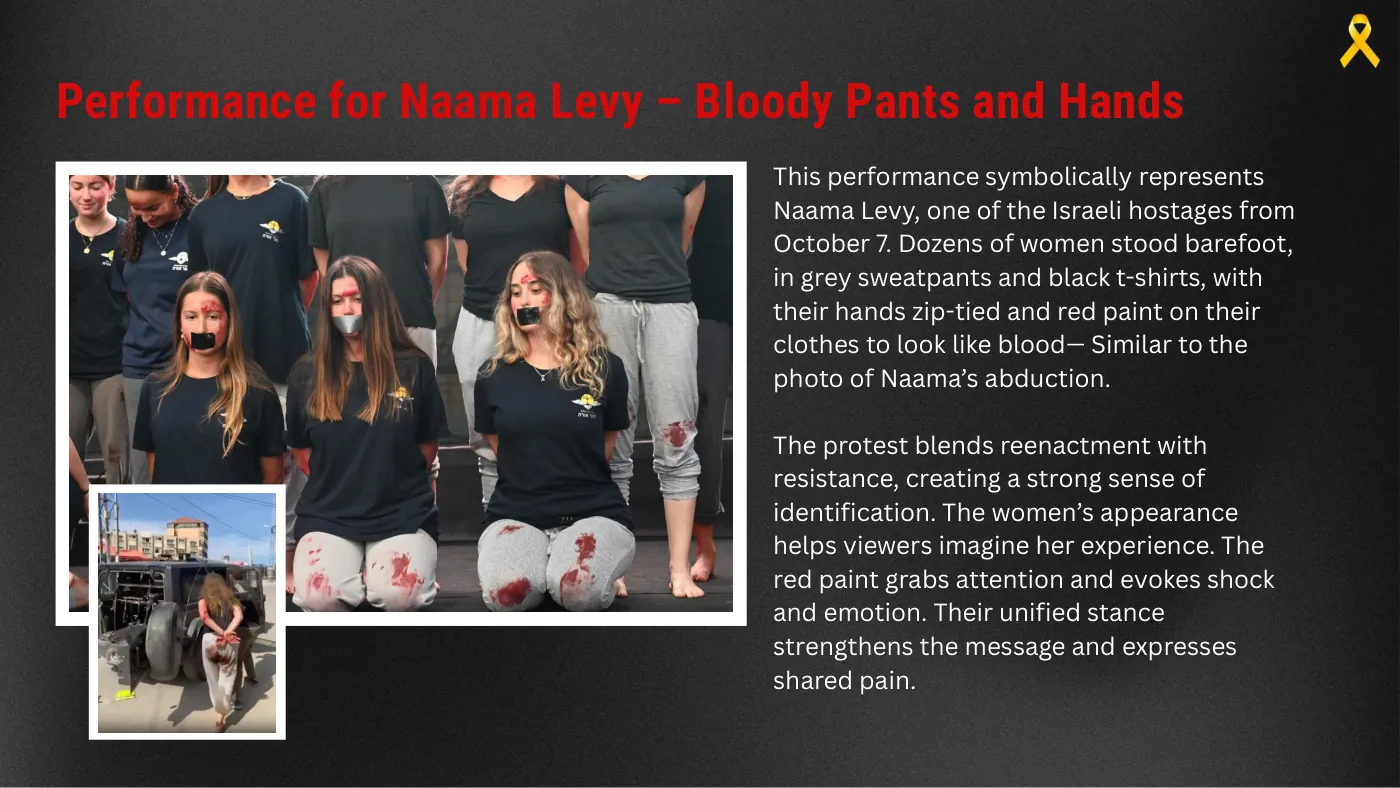
Dozens of barefoot women in gray sweatpants and black T-shirts, hands tied and red paint like blood, just as in the photo of the abduction. The performance mixes re-enactment and resistance, and produces identification: the women’s appearance helps imagine the experience; the red draws the eye and provokes shock; the unified stance expresses shared pain. It is visual activism that seeks authenticity with one’s own body and activates the social responsibility of the one who looks. The cost: it can be traumatic for those who take part and those who watch, and re-enacting a possible sexual assault opens an ethical debate.
What they add and what they cost
Two more pieces complete the reading in the written work: the yellow ribbon, a universal symbol of return applied at massive scale (lapels, cars, profiles), and the video of a hostage published by the captor as propaganda, whose force lies in a punctum nobody controls. With the five pieces seen, the balance.
Swipe sideways or use the arrows. Tap a screenshot to enlarge it.
| Example | What it does | Which tool reads it | What it costs |
|---|---|---|---|
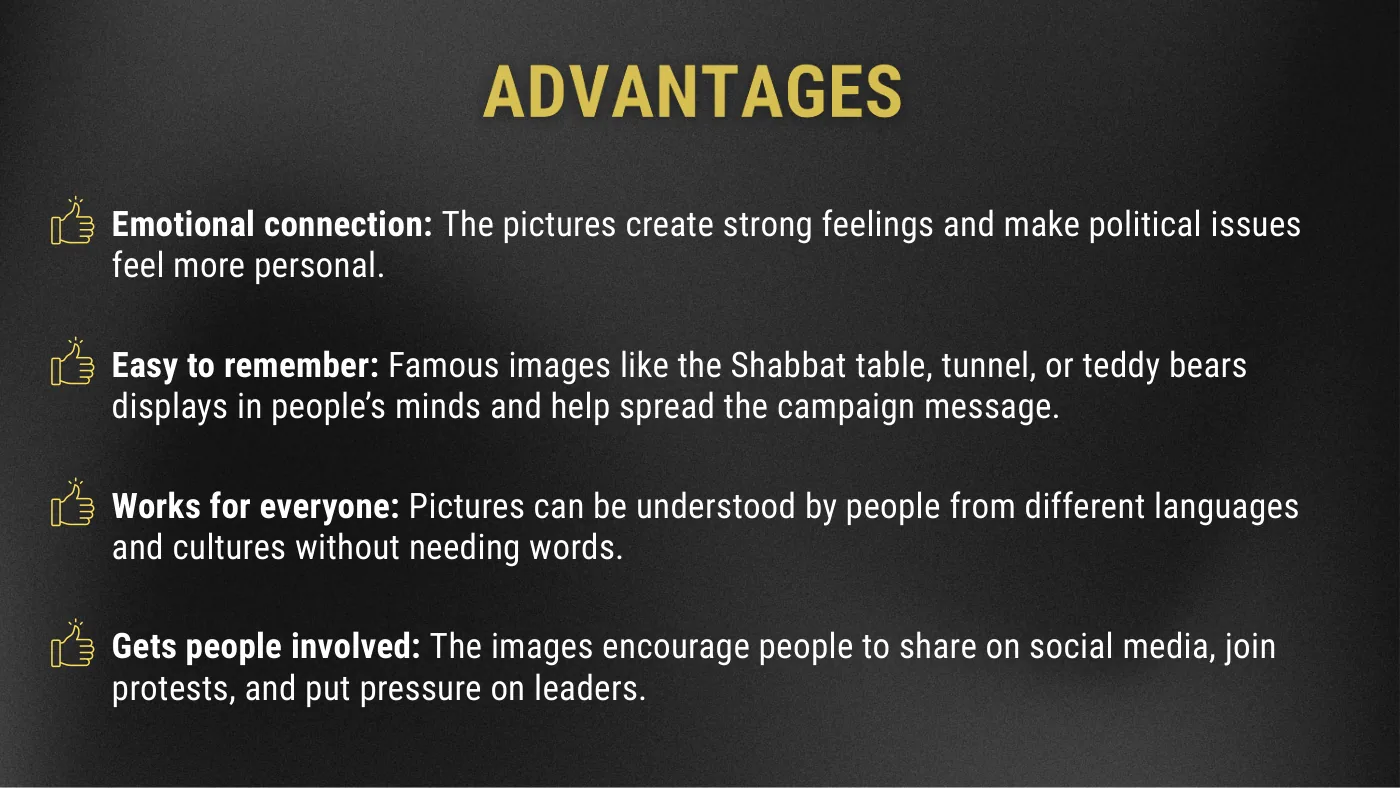
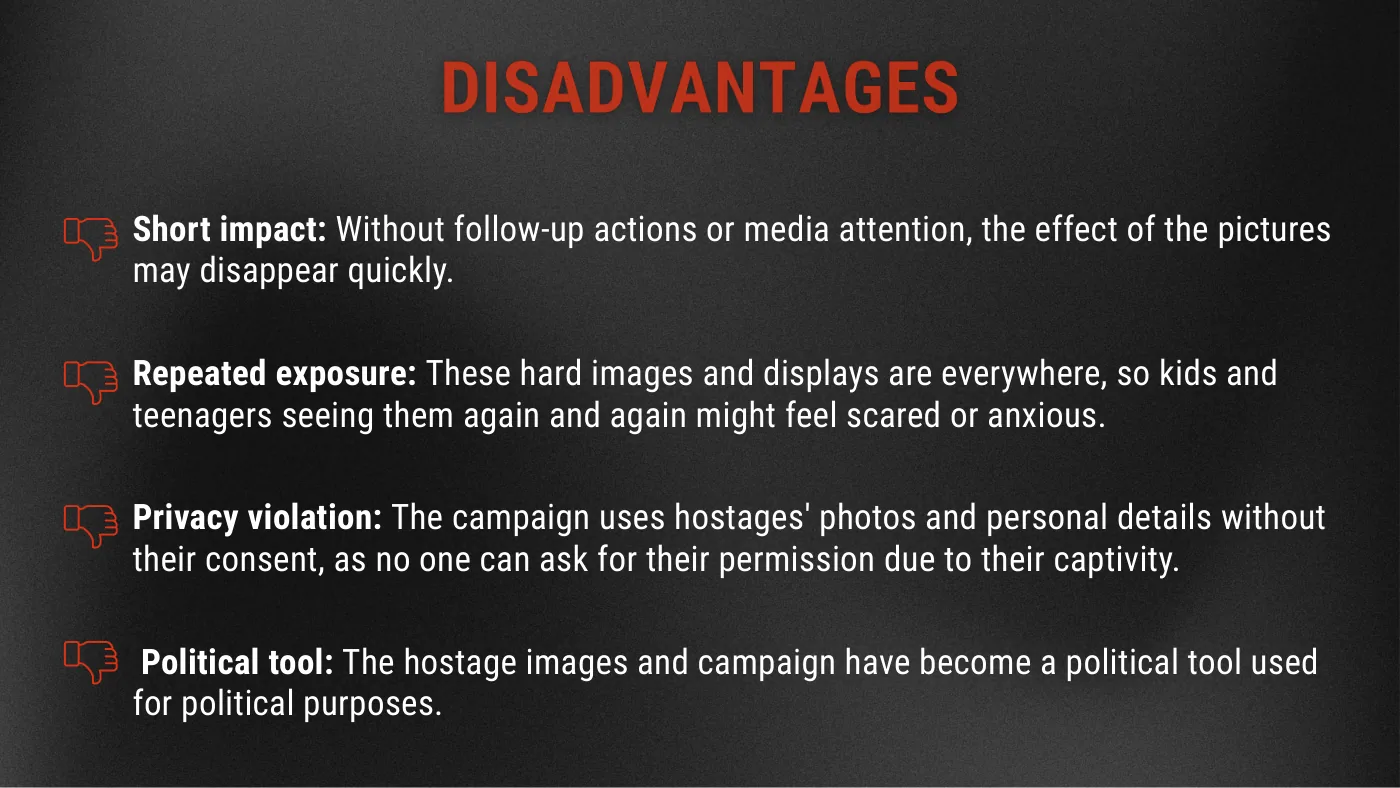
| Posters with name and age | They standardize each case (portrait, name, age) and make it part of a collective problem; the repetition in cities around the world creates rhythm and constant presence. | Thematic framing; studium (the information) and punctum (the direct gaze); Azoulay’s “presence of the absent”. | Visual fatigue from saturation; individual pain gets standardized. |
| The empty Shabbat table | It re-creates a central ritual and interrupts it: the empty chair is the presence of the one who is missing; the endless table is a tragedy that seems never to end. | Episodic framing; mythology (Barthes); the punctum of absence; color and object as discourse (Kress and van Leeuwen). | Limited to the physical space; it can be read as a solely religious message. |
| The yellow ribbon | It takes a universal symbol of return and applies it at massive scale: lapels, cars, profiles. | Mythology and priming: repetition keeps the crisis latent. | Its simplicity can dilute the urgency; risk of cliché. |
| The re-enactment of Naama Levy | Dozens of women in the same clothes, hands tied and red paint: they transfer the experience to the viewer’s body. | Visual activism; authenticity; the punctum of re-enacted pain; the social responsibility of the one who looks. | Potentially traumatic; re-enacting a possible sexual assault opens an ethical debate. |
| The video of a hostage | It is the captor’s propaganda, but its force lies in a punctum nobody controls: the real horror of the gesture, the expression, the sound of the shovel. | Authenticity that overrides ideology; multimodal analysis. | Repeated exposure to hard images; political use. |
The closing: three authors to read the campaign
Barthes gives the central pair: the studium is the information (how many hostages, which dates) and the punctum is the detail that wounds (the empty chair, the expression in a video). The campaign saturates the studium with punctums. Azoulay adds the “presence of the absent” and the civil contract of photography: each poster is a moral demand that turns the passer-by into a witness. Kress and van Leeuwen allow reading it as a whole, as multimodal discourse: color, object, space, silence and sound building a meaning that needs no words.
The work’s conclusion: by combining the semiotics of strong symbols, the framing of personal stories, the punctum of painful details and the authenticity of experience, the campaign managed to cross political divides and generate a global demand for the release of the hostages.
What a campaign takes from this
The brief asked for analysis, not a proposal. But when I analyze a campaign I do it as someone who has to build the next one, and from this one I keep four rules.
- A symbol anyone can reproduce is worth more than a perfect image. A poster with a name and an age, a yellow ribbon: formats anyone copies without asking for permission or budget. If the campaign depends on a single produced piece, it does not scale.
- The dose of pain is a design decision, not a matter of intensity. Repeating faces, bodies and wounds wins attention and, at the same time, tires people, scares children and opens ethical debates. Every strong piece needs a plan for what comes next.
- Interrupting a ritual moves people more than giving a number. 251 kidnapped informs; a Shabbat table with 200 empty chairs wounds. Look first for which ritual, which object, which silence can carry the message; the data comes after.
- You never fully control what an image ends up saying. The video the captor publishes as propaganda is read as a cry for help. It works the other way too: what a brand produces for one purpose can end up read with another. Every piece has to be looked at from the place of the person who sees it.
What I took away
A tool for looking at any campaign: separate what informs from what wounds, and ask what the image demands from the one who sees it. Also that the same decisions that make a campaign effective (repetition, the body, real pain) have a cost that has to be put on the table.