“The Engagement Paradox”: who answers for the algorithms that choose what we see
An individual essay for the ethics in the digital age course. The thesis: the social fragmentation produced by platforms is neither a design flaw nor a legal vacuum, it is an ethical dilemma: prioritizing emotional engagement over social cohesion. I analyzed it with the Potter Box method and proposed a way out through professional responsibility.

The thesis
The literature usually treats polarization on social media as a design or regulation problem. The essay argues otherwise: the core is ethical. Platforms choose the emotion that retains over the cohesion that holds a society together, and that choice is protected by indifference (Wiesel), by a “politics of deletion” (Bastos) and by the technical opacity of the systems (Binns).
The method: five steps of the Potter Box
- 1 · Facts
What recommendation algorithms do today and what gets deleted so nobody can review it.
- 2 · Values
Engagement measured in clicks versus social cohesion. Conflict as a profitable product.
- 3 · Principles
Kant: autonomy, the categorical imperative and “dare to know”. Indifference as a universal law does not hold.
- 4 · Loyalties
Whom the person who designs the system answers to: the company that pays or the society that uses it.
- 5 · Decision
Audit bias before publishing, as a professional obligation, so the user can recover their judgment.
The Potter Box is a method of ethical analysis: it is walked in this order, and the final decision has to be defensible from the four previous steps.
What each step says
Facts. According to the cited sources, content with a high emotional charge (outrage, conflict) is 90% more likely to spread than neutral content, and around 70% of watch time on video and social media is decided by automated recommendations. Add to that the “politics of deletion”: removing context, silencing dissenting voices through mass reporting and cleaning up the traces once the damage has already paid off.
Values. The efficiency of engagement against social cohesion. For the industry, social disorder is not a bug in the code: it is the sign that the attention system is running at full capacity. And indifference operates on two levels: the technical one (an algorithm blind to truth that radicalizes bias) and the moral one (companies for which the loss of civic empathy is a retention indicator).
Principles. That model attacks Kantian autonomy: if the algorithm fragments the view of the world until the other disappears as an interlocutor, it nullifies the capacity to reason universally. A society with indifference as a universal law collapses, and the user is left in a “state of minority”, far from “dare to know”.
Loyalties. Whom does the person who designs these systems answer to? Following Kasher, a professional is not just an employee who obeys: they guard a standard that protects human dignity. The developer lives a dissonance between contractual loyalty (optimizing bias to earn more) and ethical loyalty (preserving public order and mental health). And since algorithmic design is never neutral (Martin), whoever designs it is responsible for the harm.
Decision. A paradigm shift in professional responsibility: internalizing the IEEE 7003-2024 standard on algorithmic bias not as a suggestion but as a moral obligation, and auditing the biases that fracture public order before implementing. Only when the system stops manipulating perception does the user recover their sovereignty of judgment.
The sources
Bastos (2024) on the politics of deletion; Binns (2018) on algorithmic accountability; Gombar (2025) on echo chambers; the IEEE 7003-2024 standard; Kant (1784) on the Enlightenment; Kasher (2005) on professional ethics; Martin (2018) on the accountability of algorithms; Unver (2017) on the attention economy; Wiesel (1999) on the perils of indifference.
How it was written
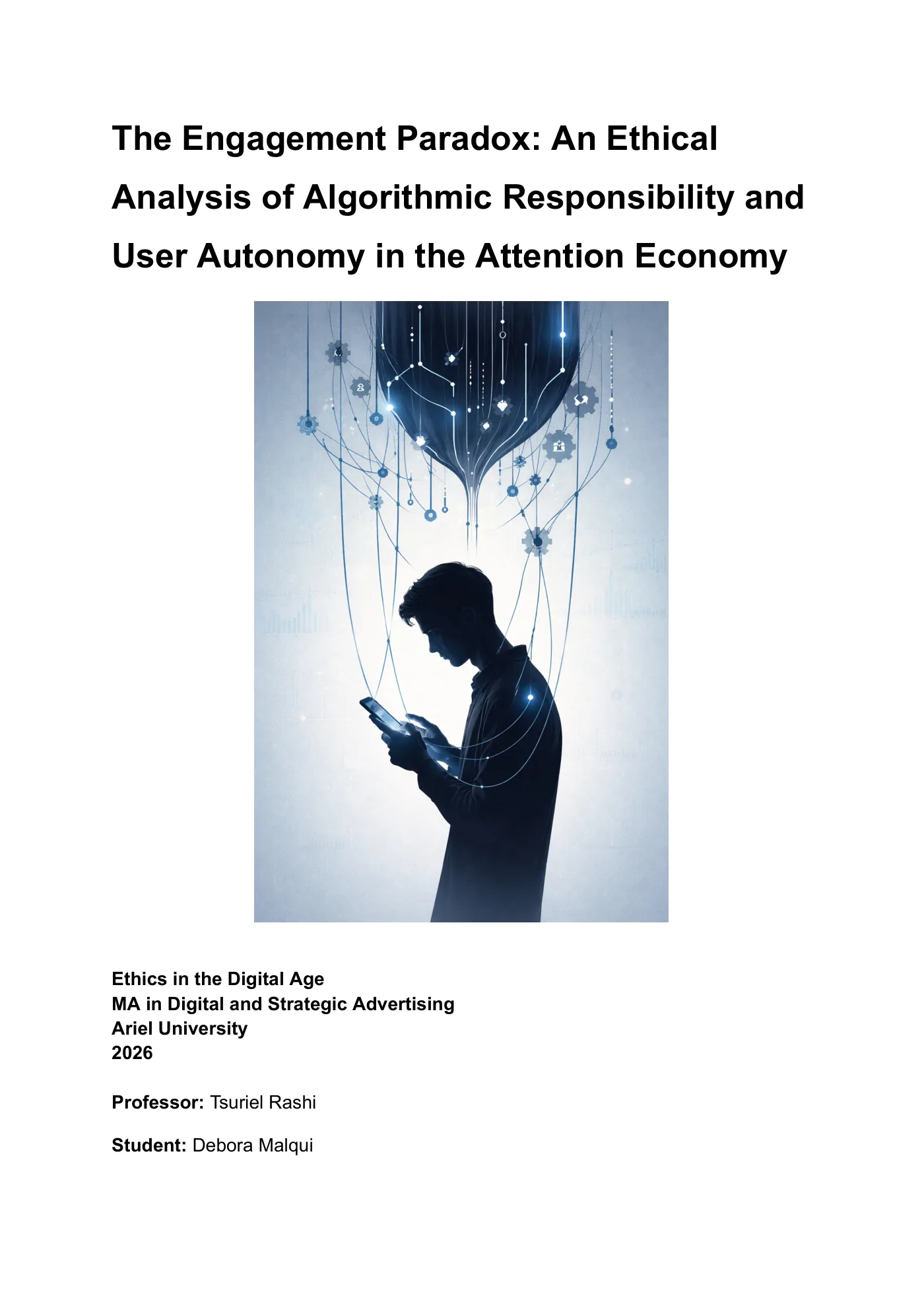
The essay carries an AI use disclosure. I set the thematic axes, the sources and the structure under the Potter Box; the AI helped synthesize concepts and polish the academic prose, and generated the cover image. I reviewed and validated every argument and every term myself. It is the same way I work today: the AI executes, the judgment is mine.